
EDITEC 4.2 INVOIC becomes mandatory from January 1, 2027: What does this mean for the HVAC sector?
EDITEC is the EDIFACT subset used in the HVAC sector (sanitary, heating, air conditioning), developed by ITEK on behalf of ARGE Neue Medien and DG Haustechnik. Based on EDIFACT D96B, it governs electronic data exchange between manufacturers and wholesalers - from orders (ORDERS) and dispatch advice (DESADV) to invoices (INVOIC). The widely used EDITEC version 3.5 will no longer be legally valid as of January 1, 2027.
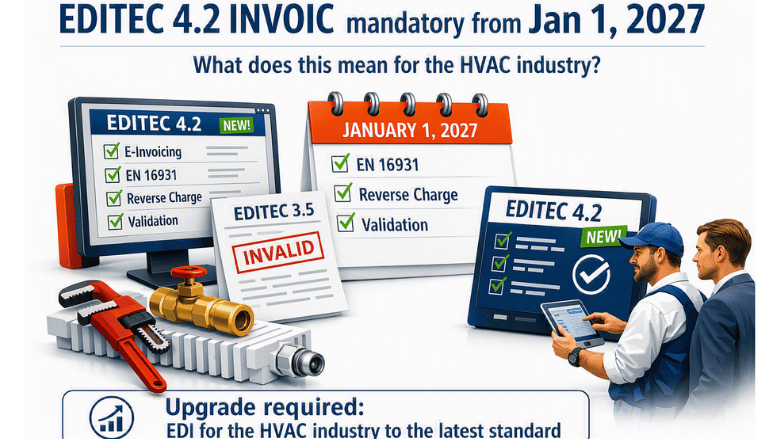
EDITEC 4.2 INVOIC becomes mandatory from January 1, 2027 – what it means for the HVAC industry
Companies in trading and the HVAC sector exchanging invoices via EDI cannot avoid an upgrade. The widely used EDITEC version 3.5 will no longer be legally valid as of January 1, 2027.
What is EDITEC?
EDITEC is the EDIFACT subset of the HVAC industry, developed by ITEK on behalf of ARGE Neue Medien and DG Haustechnik. It is based on EDIFACT D96B and regulates electronic data exchange between manufacturers and wholesalers—from orders (ORDERS) and dispatch advice (DESADV) to invoices (INVOIC).
What is EN 16931 – and why is it critical?
EN 16931 is the European standard for electronic invoicing. It defines which fields an e-invoice must contain and how they must be structured and transmitted.
Particularly relevant for the HVAC sector: EN 16931 requires the structured representation of the reverse charge procedure (§ 13b German VAT Act). The transfer of tax liability must be machine-readable and fully included in the invoice document—something EDITEC 3.5 does not support.
With the German Growth Opportunities Act (March 2024), EN 16931 became the mandatory basis for all domestic B2B invoices. EDI formats can still be used—but only if all mandatory EN 16931 fields are fully included.
EDITEC 3.5 vs. 4.2 – what changes?
EDITEC 3.5 (until Dec 31, 2026):
❌ Not EN 16931 compliant
❌ Reverse charge not fully supported
❌ Input VAT deduction not ensured
❌ Legally invalid from Jan 1, 2027
EDITEC 4.2 (mandatory from Jan 1, 2027):
✅ EN 16931 compliant
✅ Full reverse charge support
✅ Legally secure input VAT deduction
✅ Prepared for reporting requirements from 2028
✅ Validation possible via Open Datacheck SHK
What needs to be done now?
The transition affects manufacturers and wholesalers alike. Mappings must be adjusted, validations implemented, and trading partners coordinated.
The time until January 2027 may seem long—but in EDI projects, it is not. Those who start early have enough room for testing and coordination with suppliers and customers.
Do you want to implement it and have questions? Get in touch and we’ll go through it together.
 Integration
EDI Glossary: Key Terms Explained
If you are dealing with EDI for the first time, you will quickly come across abbreviations such as ORDERS, AS2, or GLN. Most of these terms originate from standards that have been around for decades and are used in projects…

aurebus teammembers E-invoice, Integration, Operations, SEEBURGER BISEDI Consulting: 5 Key Factors for Secure and Reliable Integration
Many companies look for EDI consulting when SEEBURGER BIS, APIs, e‑invoicing, or global rollouts need to run reliably. Examples such as Dr. Oetker, Bossard, edding, and Bell Food Group show what really matters in complex B2B integration.