
Personal B2B Support Instead of Offshore Call Centers – Why Companies Should Rely on Real Experts.
In many companies, B2B integration support is becoming a growing source of frustration. Tickets go unanswered for days, follow-up questions are left hanging, and when a reply finally comes, it’s often useless. The reason: support has been outsourced – typically to lower-cost regions, but also to teams with little relevant experience or process understanding.

What first appears to be a cost-saving decision often turns into an expensive detour. When support teams lack integration know-how or don’t understand the business context, problems don’t get resolved – they’re simply shifted around.
The aurebus Difference: Direct Support from Experts
At aurebus, we take a different approach.
Our customers talk directly to the people who implemented their integrations. No anonymous ticket loops, no canned responses – just fast, expert help from people who know what they’re doing.
Here’s what that means in practice:
Faster response times: We know your systems and processes – which means we can spot errors immediately.
Efficient problem-solving: No bouncing between teams – one expert contact stays on top of the issue.
Context matters: Our experts think in processes, not just tickets.
Long-term stability: Ongoing personal support prevents recurring errors.
Why This Matters for Your Business
In EDI and B2B integration, support is not just a service – it’s part of the value chain.
When orders, shipping notices, or invoices get stuck, business operations grind to a halt. Every lost hour causes real costs and strains relationships with partners.
At aurebus, you’re not investing in “support.” You’re investing in operational stability, speed, and trust.
We believe: If you take your integration seriously, you don’t need a hotline – you need a partner.
What EDI Support Must Deliver in Practice
In daily operations, companies need:
A direct contact with deep technical and process understanding
Access to mappings, logs, and test environments
Clear response time agreements
Understandable and precise feedback
Root-cause analysis – not surface-level fixes
In short: support should act like a part of your operations team – not like an outsourced ticket handler with no insight.
Next Step
Ask yourself:
How fast do you get qualified support when something goes wrong?
Does your current support partner really know your systems and integrations?
Do the same issues keep reappearing – without being properly solved?
If the answer is yes, then it might be time to rethink your support model.
At aurebus, you get personal support from the same experts who built your integration – no detours, no friction.
👉 Get in touch:Contact us now!

aurebus teammembers E-invoice, Integration, Operations, SEEBURGER BISEDI Consulting: 5 Key Factors for Secure and Reliable Integration
Many companies look for EDI consulting when SEEBURGER BIS, APIs, e‑invoicing, or global rollouts need to run reliably. Examples such as Dr. Oetker, Bossard, edding, and Bell Food Group show what really matters in complex B2B integration.
 Integration, Operations
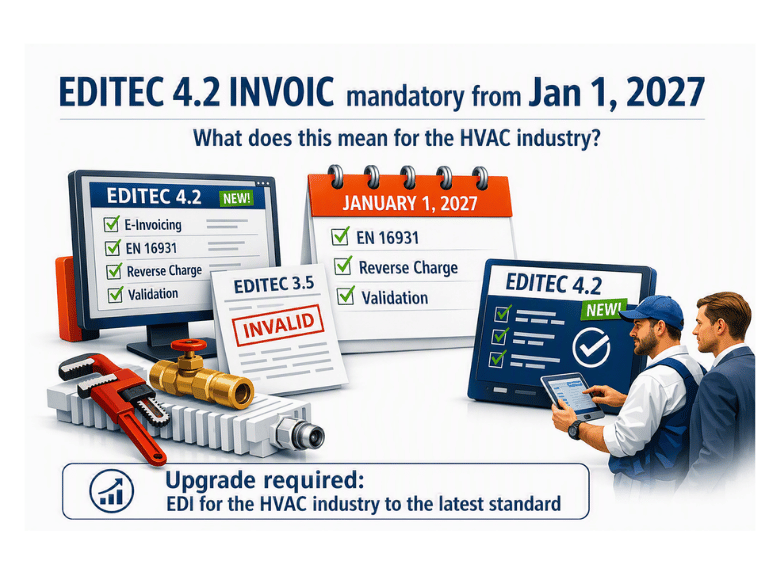
EDITEC 4.2 INVOIC becomes mandatory from January 1, 2027: What does this mean for the HVAC sector?
EDITEC is the EDIFACT subset used in the HVAC sector (sanitary, heating, air conditioning), developed by ITEK on behalf of ARGE Neue Medien and DG Haustechnik. Based on EDIFACT D96B, it governs electronic data exchange between manufacturers and wholesalers -…