
EDI Glossary: Key Terms Explained
If you are dealing with EDI for the first time, you will quickly come across abbreviations such as ORDERS, AS2, or GLN. Most of these terms originate from standards that have been around for decades and are used in projects as if everyone already knows them. To save you from having to ask about every second term, we have compiled the most important ones here. Sorted alphabetically, explained briefly, and without unnecessary technical jargon.
A
ANSI X12
U.S. EDI standard developed by the American National Standards Institute. Widely used across North America, particularly in retail, logistics, and healthcare.
API (Application Programming Interface)
An interface that enables systems to exchange data in real time. APIs increasingly complement traditional EDI wherever immediate responses are required, such as in marketplaces or online shops.
AS2 (Applicability Statement 2)
A widely used protocol for transmitting EDI data over the internet. Encrypts, signs, and automatically acknowledges every message.
AS4
The successor to AS2, based on web service standards. Among other use cases, it serves as the transport protocol for Peppol.
B
B2B Integration
A collective term for automated data exchange between business partners, typically using EDI, APIs, or a combination of both.
C
Clearing Center
A service provider acting as a central hub between multiple trading partners. Responsible for format conversion, message routing, and, in some cases, transmission security.
Converter (Mapping Tool)
Software that transforms data from a company’s internal format into the EDI format required by a trading partner and vice versa.
D
DESADV (Despatch Advice)
EDIFACT message type used for shipping notifications. Informs the recipient in advance about the contents and timing of a delivery.
E
EDI (Electronic Data Interchange)
The electronic, structured exchange of business documents between the IT systems of different companies without manual data entry or email transmission.
EDIFACT
International EDI standard developed by UN/CEFACT. It is the most widely used standard for cross-industry data exchange in Europe.
F
Factur-X
A hybrid e-invoicing format that combines a PDF invoice with embedded structured data. It is the French counterpart to ZUGFeRD, and both formats are now largely aligned from a technical perspective.
G
GLN (Global Location Number)
A globally unique identifier for companies, locations, or departments. Assigned by GS1 and used in EDI messages to clearly identify senders and recipients.
GTIN (Global Trade Item Number)
A unique product identifier managed by GS1. It forms the basis for correctly identifying products in orders and invoices.
I
INVOIC
EDIFACT message type used for electronic invoices.
M
Mapping
The process of linking data fields from one format to another, for example from an ERP system to a trading partner’s EDIFACT format.
O
OFTP2 (Odette File Transfer Protocol)
A communication protocol originating from the automotive industry. It remains the standard for many OEMs and suppliers across Europe.
ORDERS
EDIFACT message type used for purchase orders.
ORDRSP
EDIFACT message type used for order confirmations.
Onboarding (Trading Partner Onboarding)
The process of connecting a new trading partner to an EDI environment, covering both technical and organizational aspects, from format definition to successful testing.
P
Peppol (Pan-European Public Procurement Online)
A Europe-wide network for the standardized exchange of electronic documents, particularly e-invoices. It uses AS4 as its transport protocol.
S
SEEBURGER BIS
SEEBURGER’s integration platform for EDI, API, and B2B processes. It serves as the foundation for many aurebus integration projects.
V
VDA
EDI standard developed by the German Association of the Automotive Industry. Widely used between OEMs and suppliers in the German automotive sector.
VAN (Value Added Network)
A historical term for a network acting as an intermediary between trading partners to route EDI messages. Considered the predecessor of modern clearing centers.
X
XRechnung
Germany’s standard format for electronic invoices submitted to public authorities. Fully structured and without a visual invoice representation.
Z
ZUGFeRD
German hybrid e-invoicing format combining a PDF representation with embedded structured data. It is continuously updated and is currently available in version 2.4.
This glossary continues to grow with every new standard, acronym, and regulatory requirement. If there is a term missing that you encountered in a project or request for proposal, let us know.
Questions about any of these terms, or unsure which standard is relevant for your business? Klaus Dirsen and the aurebus team are happy to help you find the right answer.

aurebus teammembers E-invoice, Integration, Operations, SEEBURGER BISEDI Consulting: 5 Key Factors for Secure and Reliable Integration
Many companies look for EDI consulting when SEEBURGER BIS, APIs, e‑invoicing, or global rollouts need to run reliably. Examples such as Dr. Oetker, Bossard, edding, and Bell Food Group show what really matters in complex B2B integration.
 Integration, Operations
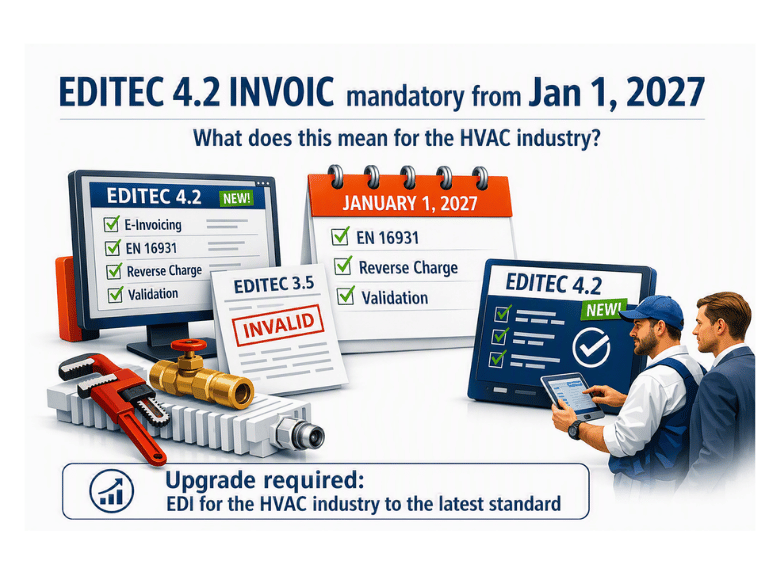
EDITEC 4.2 INVOIC becomes mandatory from January 1, 2027: What does this mean for the HVAC sector?
EDITEC is the EDIFACT subset used in the HVAC sector (sanitary, heating, air conditioning), developed by ITEK on behalf of ARGE Neue Medien and DG Haustechnik. Based on EDIFACT D96B, it governs electronic data exchange between manufacturers and wholesalers -…